Roswell Plumbing Blog
Tank vs. Tankless Water Heaters for a Roswell Home: Gas, Venting and Soft Water
How tank and tankless compare for a Roswell home on cost, gas lines, venting and maintenance, and why the city's soft water tilts the math.
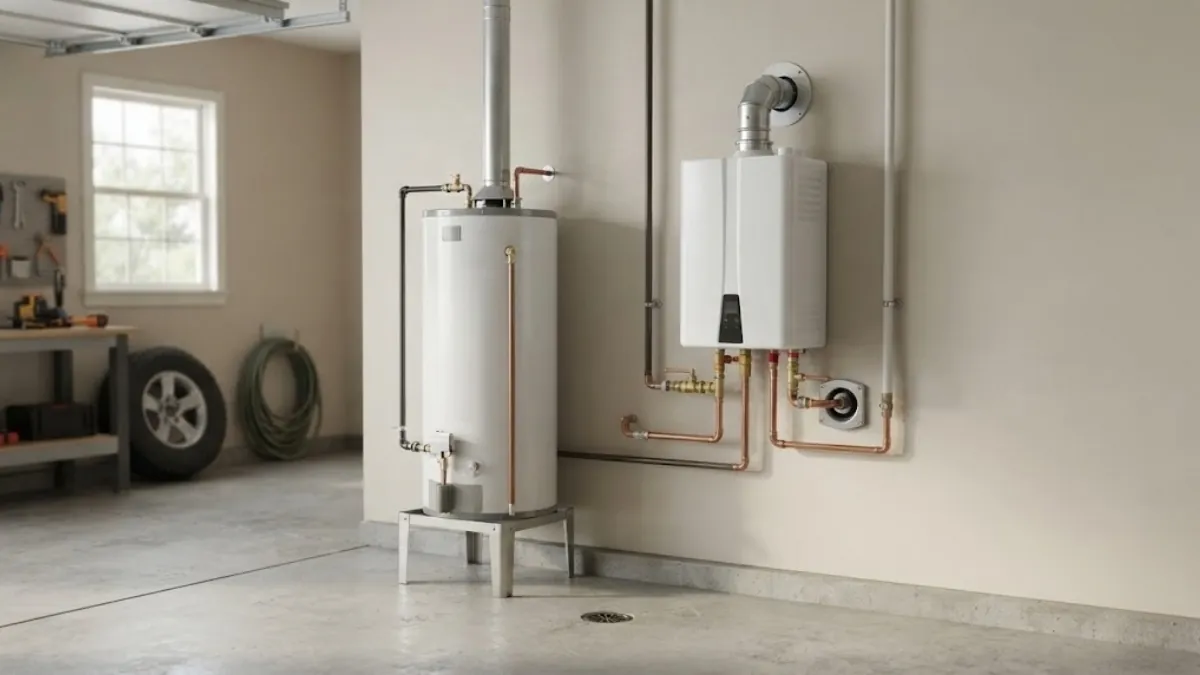
The Choice
Replacing a Water Heater in Roswell
When a tank water heater fails, most Roswell homeowners face a quick decision: replace it with another tank or switch to tankless. Both have real advantages. The right choice depends on your household, your gas service, where the heater sits and how long you plan to stay.
Roswell has a few local factors worth knowing. The water is soft, around 1.5 grains per gallon in public hardness data, which is good news for tankless units. Replacing a water heater requires a City of Roswell permit and inspection either way. And many homes in the city were built in the 1980s and 1990s with the water heater in a garage, basement or attic, which affects venting and access.
Compare
Tank Versus Tankless for a Roswell Home
The practical differences, side by side.
| Factor | Tank | Tankless |
|---|---|---|
| Upfront cost | Lower | Higher, especially with conversion work |
| Hot water supply | Limited by tank size, then recovers | Continuous, limited by flow rate |
| Energy use | Keeps water hot around the clock | Heats only when water runs |
| Space | Large footprint | Wall-mounted, compact |
| Gas line | Usually works with existing line | Often needs a larger gas line |
| Venting | Existing flue in most swaps | New venting, often PVC for condensing units |
| Maintenance | Occasional flush, anode check | Periodic descaling, filter cleaning |
Why Soft Water Favors Tankless Here
The biggest enemy of a tankless water heater is scale on its heat exchanger. In hard-water regions, units can lose efficiency within a couple of years without regular descaling. Roswell's soft water slows that down considerably, whether your supply comes from the Roswell Water Utility or from Fulton County's Chattahoochee source.
That does not eliminate maintenance. The inlet filter still collects grit, especially after nearby water main work, and manufacturers still set descaling schedules. But the long-term maintenance burden here is lighter than in many markets, which tilts the math toward tankless for households that use a lot of hot water.
Conversion Costs
Where Tankless Conversions Get Expensive
The unit is only part of the price. Large gas tankless heaters can draw far more gas at full fire than a typical tank, and older gas lines, and sometimes the meter, may not keep up. Upsizing the gas line is often the biggest extra cost.
Venting is next. Condensing tankless units usually vent through PVC, often out a side wall, and that route has to meet clearance rules. A condensate drain is needed as well. Finally, the unit needs an electrical outlet for controls.
If those items are simple in your house, a conversion is straightforward. If they are not, a high-efficiency tank or a heat pump model can be the better value. Our tankless service page covers conversions and maintenance, and the water heater replacement page covers tank and heat pump options.
What to Do Before Deciding
Answer these and the choice usually makes itself.
- Count your busiest hour. How many showers, tubs and appliances run at the same time in the morning?
- Check the gas line. Ask whether the line and meter can supply a tankless unit at full fire.
- Look at the location. Garage, basement, attic or closet, and the vent route from there.
- Think about timing. An emergency replacement favors a like-for-like tank. A planned change can go tankless.
- Include the permit. Roswell requires one for any water heater replacement.
Larger homes in nearby Johns Creek often run two tanks or one large tankless unit, and the same questions apply.
Bottom Line
A Simple Way to Decide
If your tank just failed and you need hot water tonight, a like-for-like tank is usually the practical choice. If you are planning ahead, use a lot of hot water, have gas service that can handle it and plan to stay in the house for years, tankless is worth pricing. Either way, ask for both quotes with the permit and any code updates included.
A Third Option
Heat Pump Water Heaters
A heat pump water heater looks like a tank, but it heats water by pulling heat from the surrounding air, much like an air conditioner in reverse. It uses far less electricity than a standard electric tank. For homes without gas, it is often the most efficient option available.
It has its own requirements. It needs space with enough air around it, often a garage or unfinished basement, and a place to drain condensate. It cools the room it sits in, which is welcome in a Georgia summer garage and less welcome in a small closet. Recovery can be slower than a standard electric tank in heat pump mode, though most models include a backup electric element for heavy demand.
If your home is all-electric and the water heater sits in a garage, a heat pump model deserves a place in the comparison alongside tank and tankless.
Either Way
The Permit Applies to Both Choices
Whichever direction you choose, replacing a water heater in Roswell is permitted work. The City's Community Development department states that water heaters fall under the plumbing and gas codes and require permits and inspections, and that state licensing applies when a tradesperson does the job.
A tankless conversion usually adds items to that inspection: a larger gas line, new venting and sometimes a condensate drain. A like-for-like tank swap is simpler but still gets inspected for venting, relief valve discharge and the gas connection. Budget for the permit in either case, and ask for the City's completion document before final payment. The details are on our water heater replacement page.
Questions
Tank and Tankless Questions
It usually reduces the energy used to keep water hot when nobody is using it. How much you save depends on how much hot water the household uses and what the old tank cost to run. The payback is faster in homes that use a lot of hot water and slower in small households.
Roswell's water is soft, so scale builds slowly, but most manufacturers still call for periodic descaling and many warranties depend on it. Follow the manual's schedule.
It will not run out the way a tank does, but it has a maximum flow rate. Open too many fixtures at once and the temperature drops. Sizing for your busiest hour prevents that.
Sources for This Page
Water hardness reflects public hardness data for ZIP 30075. Permit requirements come from the City of Roswell Community Development building FAQ. Conversion requirements reflect common manufacturer installation manuals.
Written by the Roswell 24/7 Plumbing team and checked against the sources above. Last reviewed October 1, 2026.
Water Heater Decision Coming Up?
Get both options priced, with the permit and code work included.
Call (770) 214-4545